 One paper has been accepted to IEEE RA-L 2026
IEEE Robotics and Automation Letters (RA-L), launched by the IEEE Robotics & Automation Society in 2015, is a leading peer-reviewed archival journal that publishes timely and concise reports of innovative research in robotics and automation. According to the 2025 release of Journal Citation Reports, based on 2024 data, RA-L has a Journal Impact Factor of 5.3 and a 5-year Impact Factor of 6.0, and is ranked in Q1 in the Robotics category.
DarkQA: Benchmarking Vision-Language Models on Visual-Primitive Question Answering in Low-Light Indoor Scenes
Authors: Yohan Park (KAIST), Hyunwoo Ha (POSTECH), Wonjun Jo (POSTECH), Tae-Hyun Oh (KAIST)
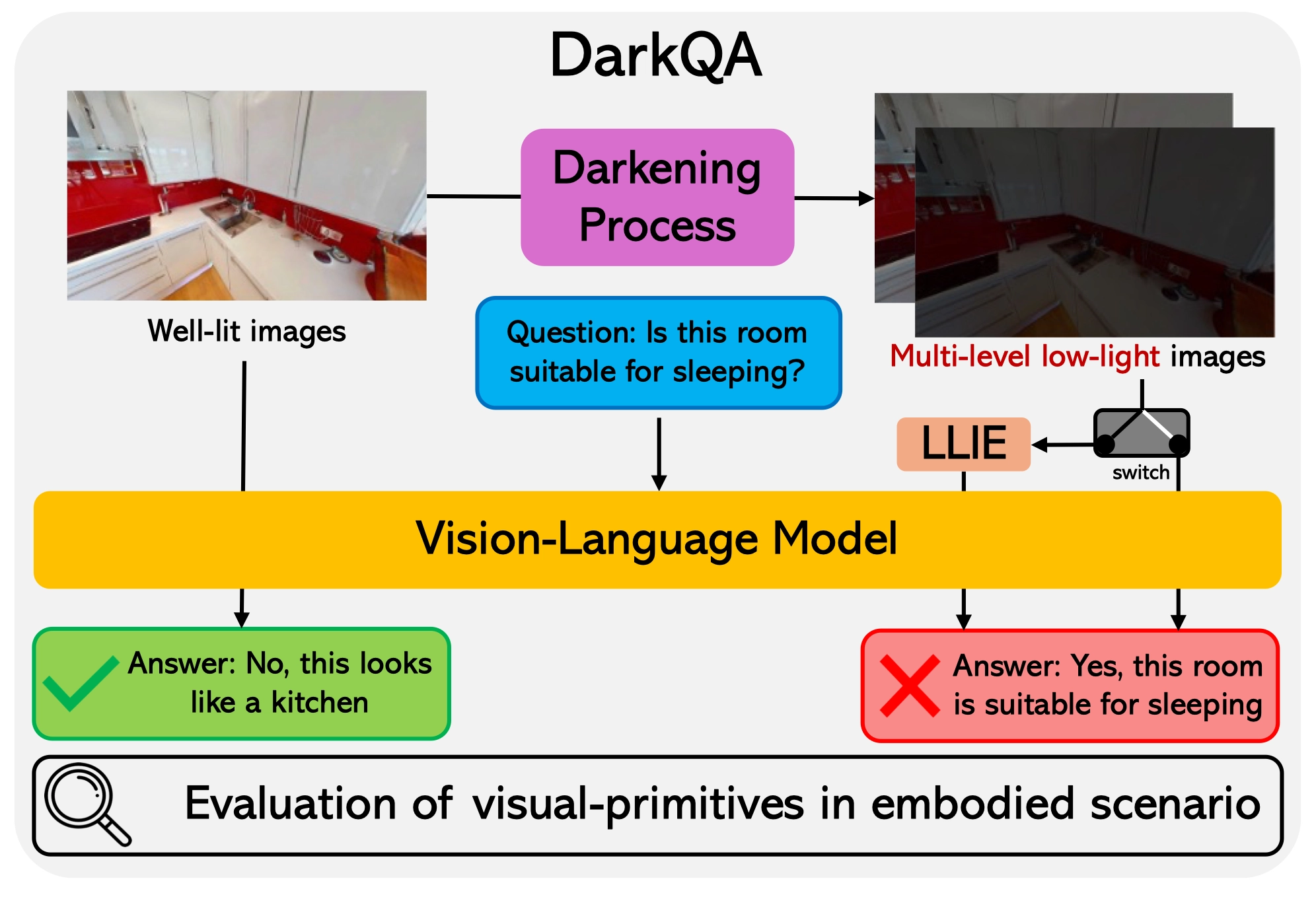
Vision-Language Models (VLMs) are increasingly used as central reasoning modules for embodied agents, yet existing benchmarks largely evaluate them under well-lit conditions. Robust 24/7 operation, however, requires reliable perception under visual degradations such as low light at night or in dark environments. We present DarkQA, an open-source benchmark for evaluating visual-primitive question answering under controlled multi-level low-light conditions in embodied scenarios. By focusing on visual primitives from egocentric observations, DarkQA isolates low-light perceptual failures before they are confounded by downstream embodied-task complexity. It contains 9.4K deterministically generated and verifiable question--image pairs spanning five visual-primitive families. To ensure physical fidelity, DarkQA models low-light image formation through inverse and forward ISP-based camera processing and RAW-domain sensor-noise injection, and validates the synthesis against real paired low-light camera data. We evaluate representative VLMs with and without Low-Light Image Enhancement (LLIE) preprocessing. Results show consistent VLM degradation under low illumination and sensor noise, while LLIE yields severity-dependent but unstable recovery.